 TabTasker
Encrypt your documents locally using a strong standard like AES-256 before sharing them anywhere. That single step puts you ahead of most people handling sensitive files. NIST's guidance on man-in-the-middle attacks makes the case plainly: even if someone intercepts your file in transit, encrypted content stays unreadable without the key. For regulated industries, HIPAA's technical safeguard requirements treat encryption as either required or strongly recommended for any electronic protected health information. The fastest, most private path is a client-side tool that never uploads your file to a server. Tabtasker's browser-based tools process files locally, so your data never leaves your device. One critical warning before you start: losing your encryption key or password means losing the file permanently. There is no recovery option.
Pro Tip: Before you encrypt anything, write down the password or key and store it somewhere physically secure, separate from the device holding the encrypted file.
Key Takeaways
Client-side encryption with AES-256, combined with strict key backup and channel separation, is the most reliable workflow for protecting sensitive documents without trusting a third-party server.
| Point | Details |
|---|---|
| Use AES-256 | Select AES-256 compatibility in every tool; older RC4 modes are no longer secure. |
| Encrypt locally | Client-side tools keep your plaintext off servers and reduce exposure to third-party breaches. |
| Separate keys from files | Always send the password through a different channel than the encrypted file itself. |
| Back up your keys | Store at least two offline copies of recovery keys; lost keys mean permanent data loss. |
| Tabtasker for local workflows | Tabtasker encrypts and processes files entirely in your browser, with no uploads or accounts required. |
Table of Contents
- What's the fastest way to encrypt and share a document safely?
- How do you encrypt different file types?
- Step-by-step: how do you encrypt a PDF?
- How can you tell if a file is encrypted, and how do you remove it?
- What are the best practices for passwords and encryption keys?
- Why does client-side encryption matter, and how does Tabtasker support it?
- What mistakes weaken your encryption workflow?
- The real problem with "good enough" encryption
- Tabtasker processes your files locally, so servers never see them
- Sources
What's the fastest way to encrypt and share a document safely?
Follow these five steps in order, and you will have a secure, shareable encrypted file in under ten minutes.
- Prepare your file. Close the document in any editing app and confirm you have the final version. Rename it something neutral if the filename itself reveals sensitive content.
- Choose your encryption method. For PDFs, use Adobe Acrobat's password protection with AES-256 compatibility selected. For Word, Excel, or PowerPoint files, use the built-in password protection option under File > Info > Protect Document. For any other file type, compress it into a 7-Zip archive with AES-256 encryption.
- Encrypt locally. Apply the password or key without uploading the file to any external server. Client-side tools, including Tabtasker's browser suite, handle this entirely on your device.
- Verify the encryption. Reopen the file and confirm it prompts for a password before displaying content. Send a test copy to yourself first.
- Share the password through a separate channel. Email the encrypted file, then call or text the password. Never send both together.
Pro Tip: AES-256 is the current standard for strong file encryption. Older modes like 40-bit RC4 are no longer considered secure against modern attacks. Always check your software's compatibility settings before applying encryption.
Full step-by-step instructions for each file type are in the sections below.
How do you encrypt different file types?
The right method depends on the file format. Each type has a recommended approach, and recipient compatibility matters as much as your own security settings.
| File Type | Recommended Method | Typical Tools | Compatibility Note |
|---|---|---|---|
| Password protection, AES-256 | Adobe Acrobat, iLovePDF (local mode) | Recipients need Acrobat Reader or any modern PDF viewer | |
| Word / Excel / PowerPoint | Encrypt with Password (built-in) | Microsoft Office | Recipients need Office or a compatible viewer to open |
| Any file type | AES-256 ZIP container | 7-Zip, AxCrypt | Recipients need 7-Zip or AxCrypt installed to decrypt |
| Folder or drive | Container or OS-level encryption | VeraCrypt, BitLocker (Windows Pro), FileVault (macOS) | Recipient must have the same tool or OS feature available |
Symmetric encryption (one shared password, AES) works well for most individual use cases because it is fast and widely supported. Asymmetric encryption (a public/private key pair, RSA) suits scenarios where you need to send a file to someone without sharing a password in advance. For everyday document protection, AES-256 with a strong passphrase covers the vast majority of needs.
WIRED's practical guide covers BitLocker, FileVault, and VeraCrypt in detail for drive-level and container encryption. Microsoft Support documents the built-in Windows encryption options, including which features are available in Home versus Pro editions.
Step-by-step: how do you encrypt a PDF?
Using Adobe Acrobat on desktop
- Open the PDF in Adobe Acrobat (not just Reader).
- Go to File > Properties > Security.
- Under "Security Method," select Password Security.
- Check "Require a password to open the document."
- In the Compatibility dropdown, select Acrobat X and later to enable AES-256 encryption.
- Enter a strong password and confirm it.
- Save the file. The original unencrypted version remains until you overwrite or delete it.
Using a client-side browser tool
For a faster, privacy-first option, Tabtasker's PDF encryption walkthrough shows how to apply password protection directly in your browser with no upload required. The file never touches a server.
Verification checklist after encrypting a PDF:
- Open the encrypted file in a fresh PDF viewer session and confirm a password prompt appears before any content loads.
- Try opening it with a different PDF app (Preview on macOS, Edge on Windows) to confirm cross-viewer compatibility.
- Check File > Properties > Security in Acrobat to confirm the encryption method shows AES-256, not RC4.
- Send the encrypted file to your own email and open it on a second device to simulate the recipient's experience.
Privacy warning: Many free online PDF tools upload your file to a remote server for processing. Once uploaded, you have no control over how long that file is retained or who can access it. Virtru's overview of client-side encryption explains why encrypting data before it leaves your device is the only way to guarantee the server never sees plaintext. If a tool requires an upload before it offers encryption, look for a different option.
How can you tell if a file is encrypted, and how do you remove it?
Confirming encryption before you share a file takes thirty seconds and saves real problems later.
How to check encryption status:
- PDF: Open in Adobe Acrobat, go to File > Properties > Security. The Security Method field will show "Password Security" and list the encryption algorithm if protection is active.
- Office files: Open the file in Microsoft Office, go to File > Info. A yellow "Permissions" banner with a lock icon confirms encryption is active.
- ZIP archives: Open 7-Zip and browse to the archive. Encrypted files show a lock icon in the file list.
- Windows EFS or BitLocker: Right-click the file or folder, select Properties > Advanced. A checkmark next to "Encrypt contents to secure data" confirms EFS encryption is active.
How to remove encryption when you have the password:
- PDF: In Acrobat, go to File > Properties > Security, change Security Method to "No Security," enter the current password when prompted, and save.
- Office files: Go to File > Info > Protect Document > Encrypt with Password, delete the password field entirely, and save. Wayne State University's guide walks through this process for each Office application.
- 7-Zip archive: Extract the contents using the correct password, then re-compress without encryption.
Lost your key or password? The file is unrecoverable. There is no backdoor, no support ticket that will help. This is why key backup, covered in the next section, is not optional.
What are the best practices for passwords and encryption keys?
Strong encryption with a weak password is still weak. The password is the lock; the algorithm is just the door material.
Creating strong passphrases:
- Use a passphrase of at least four random words rather than a short complex password. Length provides more entropy than special characters alone.
- Store every encryption password in a dedicated password manager such as Bitwarden or 1Password, not in a notes app or browser autofill.
- Never reuse an encryption password across multiple files or accounts.
Backing up keys and recovery certificates:
- For OS-level encryption like BitLocker, export the recovery key immediately after setup and store it somewhere physically separate from the encrypted device. Microsoft Support documents this step and notes that Home edition users do not have BitLocker access.
- Keep at least two offline copies of any private key or recovery certificate, stored in different physical locations.
- For asymmetric key pairs, consider secure backup methods that include encrypted external drives or printed key backups stored in a locked location.
Dos and don'ts:
- Do separate the encrypted file and its password into different communication channels.
- Do test decryption on a second device before deleting the unencrypted original.
- Don't email the password in the same thread as the encrypted attachment.
- Don't rely on a single digital copy of a recovery key.
Pro Tip: A passphrase like "correct-horse-battery-staple" is both memorable and far harder to brute-force than "P@ssw0rd1." Read more about generating strong passwords before you set your encryption credentials.
Why does client-side encryption matter, and how does Tabtasker support it?
Client-side encryption (CSE) means your file is encrypted on your own device before it goes anywhere. The server, if one is involved at all, only ever receives ciphertext. As Virtru's file encryption guide explains, this approach prevents storage providers from accessing plaintext, which is the core privacy guarantee most cloud-based tools cannot offer.

The practical difference is significant. When you use a server-side tool, you are trusting that provider's security practices, data retention policies, and legal obligations. When you encrypt locally, none of that matters because the server never sees your content.
A client-side workflow using Tabtasker:
- Open your file directly in Tabtasker's browser tools. No account, no upload.
- Apply encryption or password protection locally. The operation runs in your browser using your device's processing power.
- Save the encrypted file to your local drive.
- Share the file through your preferred channel, then send the password separately.
The tradeoff is worth understanding. Local processing means full recovery responsibility sits with you. There is no "forgot password" option, no server-side key escrow to fall back on. For most individuals handling sensitive personal or professional files, that tradeoff is the right one. For enterprise scenarios with compliance requirements around key custody, a managed key-management service may still be appropriate alongside CSE tools. Tabtasker's approach to keeping files in the browser explains the privacy architecture in more detail.
What mistakes weaken your encryption workflow?
Good intentions with poor execution leave files exposed. These are the errors that actually matter.
- Using outdated encryption settings. Selecting RC4 or 40-bit compatibility modes in Adobe Acrobat produces encryption that modern hardware can crack quickly. Always select AES-256 where the option exists.
- Sending the password with the file. If someone intercepts your email, they get both. Use a phone call, a separate messaging app, or an in-person exchange for the password.
- Uploading to a server-side "encryption" tool. If the tool processes your file on a remote server, your plaintext was exposed during that process regardless of what happens afterward.
- Skipping the verification step. Applying encryption without testing it means you might send a file the recipient cannot open, or worse, one that was never actually encrypted.
- No key backup. Losing the password to an encrypted file is permanent data loss. No backup means no recovery.
- Red flag: a tool asks for your private key. Legitimate encryption tools never need your private key. If a service asks you to upload or share it, stop immediately.
Quick fixes: update your software's compatibility settings to AES-256, use separate channels for keys, export recovery certificates right after setup, and always test decryption before deleting the original.
The real problem with "good enough" encryption
Most people who lose access to encrypted files did not use a weak algorithm. They used a weak workflow. They encrypted the file, emailed the password in the same message, skipped the verification step, and stored the only copy of their recovery key on the same device as the encrypted data. The algorithm was fine. Everything around it was not.
The tools available today, from Microsoft Office's built-in encryption to 7-Zip to Tabtasker's browser-based suite, are genuinely capable. AES-256 is strong enough that the bottleneck is almost never the cryptography. It is the human decisions: password strength, key storage, channel separation, and whether you actually tested that the recipient can open the file.
Client-side encryption is worth prioritizing not because server-side tools are always malicious, but because you cannot audit their security practices. Keeping files local removes a variable you cannot control. That said, the best encryption workflow is one you will actually follow consistently. A method you use every time beats a theoretically superior one you abandon after two files.
Tabtasker processes your files locally, so servers never see them
Most encryption guides end with a tool recommendation that still requires you to upload your file somewhere. Tabtasker works differently. Every operation runs directly in your browser, on your device, with no server involved and no account required.
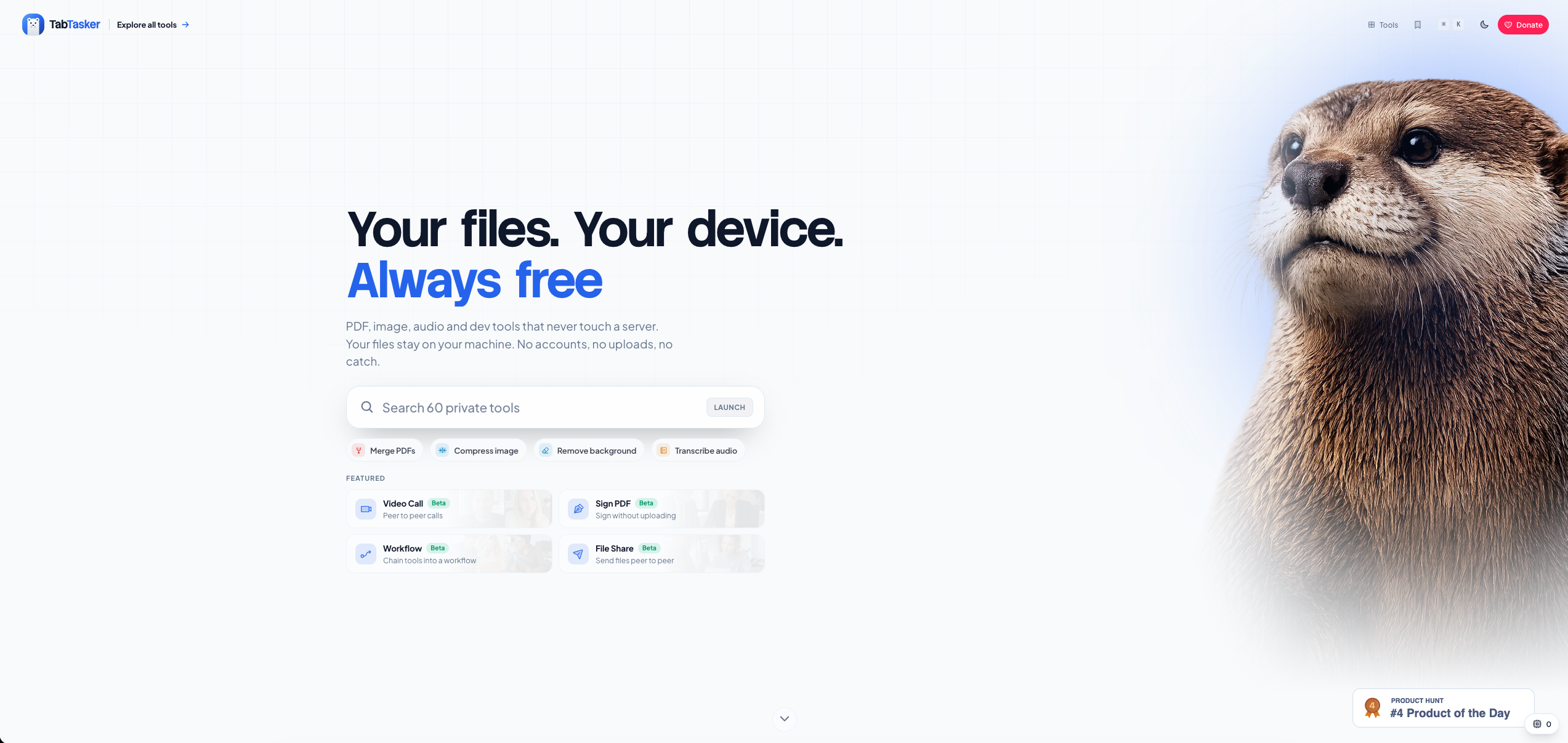
For document encryption specifically, that means you can encrypt and share files without your plaintext ever leaving your machine. Tabtasker's suite covers PDF tools, file operations, image processing, and audio editing, all processed locally. There are no hidden upload steps, no data retention questions to worry about, and no subscription needed to get started. If you are handling sensitive documents and want a workflow that matches the privacy standards this guide recommends, try Tabtasker's free offline tools now.
Sources
These official and expert sources provide deeper technical background and platform-specific steps for document encryption.
- How To Encrypt a File or Folder | Microsoft Support
- NIST glossary: man_in_the_middle_attack
- HIPAA laws and regulations (HHS)
- The Complete Guide to File Encryption: 2024 Update
- Encrypt & Password Protect Documents
- How to Encrypt any File, Folder, or Drive on Your System | WIRED
For compliance questions specific to your industry (HIPAA, financial regulations, legal privilege), consult the relevant primary source or a qualified professional. General encryption best practices apply broadly, but regulatory requirements vary by sector and use case.