 TabTasker
Three offline routes turn images into a PDF without touching the internet: your operating system's built-in Print or Export function, a dedicated desktop app for large batches, and a local browser tool like Tabtasker that processes files client-side. Pick built-in tools for a quick, one-off job, a desktop app when you're converting hundreds of files or mixed formats, and a browser-based tool such as Tabtasker's Images To PDF converter when privacy matters and you don't want to install anything.
TL;DR:
- Built-in OS tools handle common formats like JPG and PNG quickly and for free but have limited support for HEIC and awkward page reordering.
- Batch conversion apps and browser tools like Tabtasker support multiple formats and privacy, with no image caps or data leaving your device during processing.
- Mac Preview allows easy multi-image PDF creation with drag-and-drop ordering and supports HEIC files natively, unlike Windows.
- Android and iPhone images can be converted offline through the sharing menu, with HEIC images converting seamlessly on iPhone and dependently on device support on Android.
- True offline conversion verification involves checking that no network requests fire during the process, ensuring your files remain private and local.
Table of Contents
- What Are the Fastest Ways to Convert Images to PDF Offline?
- How Do You Convert JPG to PDF Offline on Windows?
- How Do You Convert Images to PDF on macOS?
- Can You Convert Images to PDF Offline on iPhone or Android?
- How Do You Keep Image Quality and Transparency Intact?
- What Are the Batch Limits on Free Image-to-PDF Tools?
- How Do You Verify a Tool Is Actually Offline?
- When Offline Conversion Actually Matters
- Convert Images to PDF Without Installing Anything
- Sources
What Are the Fastest Ways to Convert Images to PDF Offline?
Every offline method trades off speed, format support, and how much you have to install. Here's the honest breakdown.
- OS built-in tools (Windows Print to PDF, macOS Preview): Free, already on your machine, zero setup. Handles JPG and PNG well but chokes on HEIC without a workaround, and reordering pages is clunky.
- Desktop apps for bulk jobs: Installed software built specifically for image-to-PDF conversion. Some advertise full offline processing with support for JPG, PNG, HEIC, WebP, and TIFF, with no server-side caps because everything happens on your device.
- Local browser tools (no install): Tools like Tabtasker run entirely in your browser tab using client-side code. No account, no upload, and no software footprint left behind.
- Mobile built-ins (iOS/Android): Fast for a handful of photos straight from your camera roll, but page reordering and batch limits get frustrating past 10 to 15 images.
- Command-line utilities: Fastest for power users scripting repetitive conversions, but it demands comfort with a terminal, which rules it out for most people.
Transparency preservation matters here too. PNG files with alpha channels usually flatten to white or black backgrounds once dropped into a PDF, so if you're converting a logo or a screenshot with transparent edges, check the output before you trust it. Install-free options like browser tools skip the "did this leave something on my hard drive" question entirely, which is worth something if you're on a borrowed or work-issued computer.
How Do You Convert JPG to PDF Offline on Windows?
Windows gives you two native paths, plus a browser fallback for when you need more control without adding software.
- Open the image in Photos or File Explorer's preview pane.
- Select Print (Ctrl+P works in most apps), then choose "Microsoft Print to PDF" as your printer.
- Set page size and orientation in the print dialog. Photo Size Full Page removes borders; check "Fit picture to frame" if your image doesn't match the page ratio.
- Click Print, then choose a save location. Windows generates the PDF instantly, no internet required.
- For multiple images, select them all in File Explorer first, right-click, and choose Print. This queues them into a single PDF in the order selected, so arrange your file names numerically beforehand if sequence matters.
That workflow covers JPG and PNG cleanly. HEIC files, common from iPhones transferred to a PC, often need a codec extension installed first, or conversion to JPG before the print dialog will even recognize them.
For bigger jobs, a dedicated app makes more sense than repeating the print dialog fifty times. Just watch the fine print: some Microsoft Store converter apps cap the free tier at 20 images per PDF, then ask for a one-time Pro unlock at a small cost to remove that ceiling. If you'd rather skip installing anything at all, Tabtasker's Images To PDF tool runs the same job locally in your browser with no image count gate.
Pro Tip: If your batch mixes HEIC, PNG, and JPG in one folder, convert the HEIC files to JPG first using a local tool. Mixed-format print jobs sometimes reorder pages unpredictably in the Windows print queue.
How Do You Convert Images to PDF on macOS?
Preview is the quiet workhorse of macOS, and most people never learn its PDF trick.
- Open all your images at once in Preview by selecting them in Finder, right-clicking, and choosing "Open With > Preview." This loads them into one window with a sidebar.
- Show the sidebar (View > Thumbnails) and drag images into your preferred order.
- Select all thumbnails, then go to File > Print.
- Click the PDF dropdown at the bottom left of the print dialog and choose "Save as PDF." This combines every selected image into one multi-page file, no third-party software involved.
- For a single image, use File > Export instead, which gives you more control over resolution and quality settings than the print path does.
HEIC images work natively in Preview since macOS handles that format at the system level, which is one advantage over Windows here. Transparency in PNG files generally survives the export path better than the print path, so if alpha channels matter, export individually rather than batch printing.
Where Preview falls short is page sizing precision and OCR. If you're digitizing scanned documents and need searchable text, or you need exact page dimensions for a form, a dedicated offline app that lists JPG, PNG, HEIC, WebP, and TIFF support will save you the fiddling.
Can You Convert Images to PDF Offline on iPhone or Android?
Both platforms bury the feature inside the Share menu rather than a dedicated app, which is why so many people never find it.
On iPhone:
- Open Photos, select your images, tap Share.
- Tap Print, then pinch outward on the print preview thumbnail.
- This opens a full-page view of your images as a document. Tap the Share icon again and choose Save to Files, which saves it as a PDF.
On Android:
- Open Gallery or Google Photos, select your images, tap Share.
- Choose Print from the share sheet.
- Select Save as PDF from the printer dropdown (the exact wording varies by phone brand, since Samsung, Pixel, and others each skin this menu differently).
Both methods work entirely offline since there's no cloud printer involved, just a virtual PDF driver built into the OS. HEIC photos convert without extra steps on iPhone because that's the native format. On Android, HEIC support depends on the phone's manufacturer, so test with one photo before committing to a 40-image batch. Mixing formats, say three screenshots and twelve camera photos, into one PDF works fine on both platforms as long as you select them all before tapping Share.
How Do You Keep Image Quality and Transparency Intact?
Resolution loss during conversion usually comes down to one setting: whether the tool scales images down to fit a standard page size or embeds them at native pixel dimensions. For photos you'll print, matching to page size (Letter or A4) makes sense. For images you'll only view on screen, like scanned receipts or reference material, embedding at native resolution avoids unnecessary compression.
Format choice matters before you even start converting. PNG preserves transparency and sharp edges, which makes it the right call for logos, screenshots, and diagrams with text. JPG compresses more aggressively and drops transparency entirely, but it's the better choice for photographs since file sizes stay manageable without visible quality loss at reasonable settings.
Color accuracy is where things quietly go wrong. Some conversion tools flatten a photo's embedded color profile to generic sRGB, which can shift skin tones or brand colors just slightly. If you spot banding or a color cast that wasn't there before, the converter likely stripped the color profile during processing. Local, client-side tools tend to handle this better than they get credit for, since they aren't compressing files for faster network transfer the way cloud converters often do.
What Are the Batch Limits on Free Image-to-PDF Tools?
Free doesn't always mean unlimited, and the caps show up in different places depending on the tool.
- Some Microsoft Store apps restrict the free tier to 20 images per PDF, pushing you toward a small paid unlock for larger jobs.
- Desktop apps installed directly on your machine, rather than through an app store, often skip this entirely since there's no server-side quota to enforce.
- Browser-based tools that process everything client-side, meaning inside your own browser tab rather than on a remote server, also tend to avoid artificial caps, since there's no server cost tied to how many images you convert.
If you hit a wall on a capped app, splitting your batch into two smaller runs and merging the resulting PDFs afterward is a workable patch, though it's an extra step you shouldn't need. Paid software earns its price when you need OCR (text recognition inside scanned images), automated page templates, or watermarking at scale. For a one-time job of converting forty vacation photos into a shareable PDF, that expense isn't justified when free, uncapped local options exist.
How Do You Verify a Tool Is Actually Offline?
"Offline" gets used loosely in app store listings, so verifying it yourself takes about thirty seconds and a browser you already have open.
- Open Developer Tools by pressing F12 (or right-click anywhere on the page and select "Inspect").
- Click the Network tab, then clear any existing entries.
- Trigger your image-to-PDF conversion as you normally would.
- Watch the Network panel. If the tool is genuinely client-side, you'll see zero outbound requests firing during the actual conversion step. Some browser-based converters explicitly document this behavior, running the conversion through in-browser code libraries rather than sending files anywhere.
Beyond the DevTools check, a few practical signals tell you the same story without needing a technical background. Genuinely local tools also don't require you to create an account before converting a single image.
Pro Tip: If you see a POST or PUT request firing to a domain you don't recognize the moment you hit "convert," that's your file leaving the device. Close the tab.
Red flags worth remembering: mandatory sign-in, a feature list that only works "with an internet connection," or upload progress bars on a tool that claims to be offline. Any of those means your files are traveling somewhere, and online converters carry real exposure risk for sensitive files that never applies to something running entirely on your device.
When Offline Conversion Actually Matters
There's a real difference between "offline is nice to have" and "offline is the only acceptable option," and it's worth knowing which situation you're in before you reach for whichever converter loads fastest.
Scanning a passport, a medical record, or a court filing into a PDF is not the moment to trust a cloud tool you found through a search ad. The same goes for anyone working on a restricted corporate network where uploading anything to an unapproved domain could trip a compliance flag. In those cases, the convenience of a cloud converter isn't worth the exposure, and a local tool that never sends the file anywhere is the only defensible choice.
For lower-stakes jobs, a vacation photo album, a recipe scan for a friend, cloud tools are mostly fine. But the habit of defaulting to local tools costs you nothing and protects you when it counts. One practical reminder regardless of method: keep your original images until you've opened and checked the finished PDF. Conversion bugs are rare, but they're not zero, and a corrupted PDF is a bigger problem if you've already deleted the source file.
— Vehicularis
Convert Images to PDF Without Installing Anything
Tabtasker skips the install-and-hope cycle entirely: no software to download, no account to create, and no file ever leaves your device during conversion. The Images To PDF tool runs the entire process client-side in your browser tab, which means the network check described earlier will show exactly what you want to see: nothing going out.
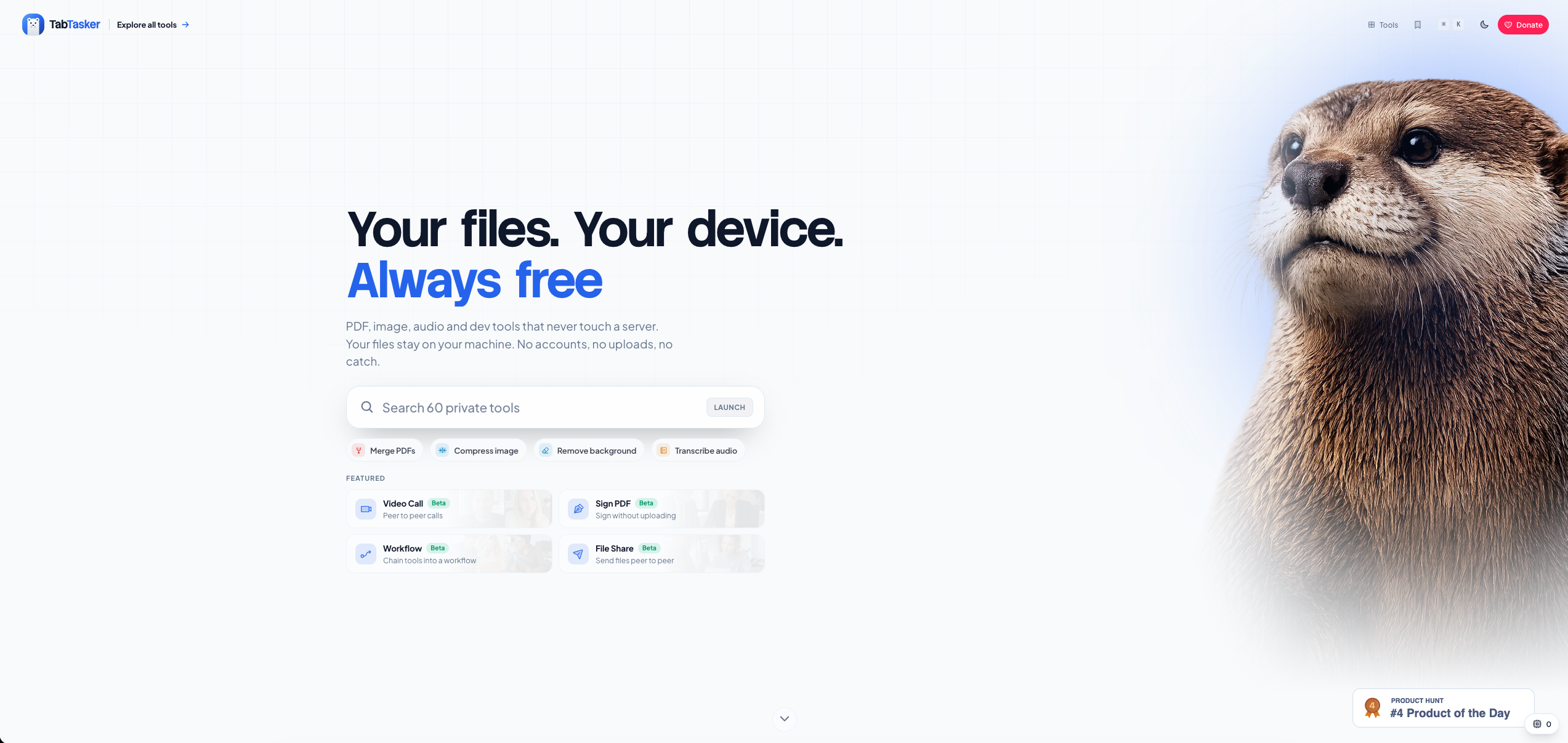
That local-processing approach suits mixed-format batches, including JPG, PNG, HEIC, and WebP in one folder, without the format gymnastics some desktop apps demand. It's also a practical choice for privacy-sensitive documents, since there's no upload step to expose them in the first place. If you need to resize, rotate, or clean up images before combining them into a PDF, the image converter handles that groundwork in the same no-upload environment. Open the Images To PDF tool now, drop in your files, and check your own browser's Network tab while it converts. You'll see the download start locally, with nothing sent anywhere else.