 TabTasker
TL;DR:
- Private, offline AI image editing tools process images on your device, ensuring sensitive data stays local. They range from browser tools to desktop apps, with cloud options offering more features but less privacy. Tabtasker provides client-side background removal, resizing, compression, and OCR without uploads or sign-up.
The practical types of free AI image-editing tools that run client-side or offline are: browser-local web tools (WebAssembly/WebGPU), packaged local-model desktop apps, browser extensions with local processing, lightweight CLI tools using Python and a local model, and hybrid offline-capable plugins for existing editors. If you need one option you can use right now without uploading a single file or creating an account, Tabtasker covers the most common tasks — background removal, resizing, compression, and OCR — entirely in your browser. Your files never leave your device. That distinction matters most when you're handling sensitive images, and it's worth understanding why before you reach for any "free" tool that asks for nothing upfront.
Table of Contents
- What types of free AI image editing tools run client-side or offline?
- Privacy vs. capability: what you actually give up with each approach
- What to look for when choosing a privacy-first free AI image editor
- Which tool type handles each common offline AI image task best?
- How Tabtasker fits a private, offline image-editing workflow
- What hardware and browser do you actually need for offline editing?
- Key Takeaways
- Why privacy-first tools deserve more credit than they get
- Tabtasker handles private image editing without the trade-offs you'd expect
- Further reading and primary sources
What types of free AI image editing tools run client-side or offline?
The market has matured past the question of whether free tools can do the job. The real question now is which tool type fits your workflow philosophy. Here are the five practical categories:
- Browser-local web tools run entirely in your browser using WebAssembly (WASM) or WebGPU pipelines, processing images on your device without any server contact. Common tasks: background removal, compression, resizing, and basic OCR.
- Packaged local-model desktop apps download a model to your machine and run inference locally. They handle more complex tasks like inpainting and upscaling, but require setup and meaningful storage.
- Browser extensions with local processing hook into your existing browser session and process images client-side via injected scripts. Useful for quick, repetitive edits on images you're already viewing.
- Lightweight CLI/scriptable tools (Python plus a local model such as rembg or Real-ESRGAN) give technically inclined users full control, no GUI required. Ideal for batch jobs and automation.
- Hybrid offline-capable plugins for editors like GIMP or Krita add AI features that call a local model rather than a remote API, keeping the workflow inside software you already trust.
Pro Tip: If your workflow involves iterating on more than a handful of images, a packaged local-model app often outperforms a browser-local tool. The model stays cached in memory between runs, so you skip the reload penalty that browser-local tools incur on each session.
Privacy vs. capability: what you actually give up with each approach
Client-side tools minimize data exposure, but that design choice carries real trade-offs. Privacy-first offerings are deliberately minimal in features to preserve local-only guarantees — that's a feature, not a bug, once you understand the reasoning.
| Dimension | Client-side / offline | Cloud-based |
|---|---|---|
| Data privacy | Files stay on your device | Files uploaded to external servers |
| Model size | Limited by device RAM/VRAM | Unlimited server-side compute |
| Speed | Depends on your hardware | Usually faster on good connections |
| Content filters | None (you control the model) | Strict; quotas and filters can interrupt work |
| Usage quotas | None | Credit-based limits common on free tiers |
| Workflow friction | Slightly higher setup | Lower setup, higher ongoing friction |
Cloud editors often impose censorship and usage quotas that frustrate independent artists and privacy-focused users. That drives a growing number of people toward local-first solutions for creative control. Before you trust any tool with sensitive images, run through this checklist:
- Does the tool explicitly state "no uploads" or "client-side processing"?
- Does it strip EXIF metadata from exported files?
- Is the source code open or auditable?
- Does it require an account or email to function?
- Are there hidden credit limits that will stop your workflow mid-task?
What to look for when choosing a privacy-first free AI image editor
Start with the must-haves before you evaluate features. A tool that fails any of these isn't worth your time if privacy is the goal:
- Confirm client-side processing. Look for explicit language like "no uploads" or "processed locally." If the privacy claim is buried in a FAQ or absent entirely, treat that as a red flag.
- Test a small batch first. Run two or three non-sensitive images through the tool before you touch anything confidential. Watch your network tab in browser DevTools — outbound requests during processing are a warning sign.
- Check EXIF stripping. Export a test image and inspect its metadata with a tool like ExifTool. Location data, device identifiers, and timestamps should be absent from the output.
- Verify export formats. The tool should let you export to standard formats (PNG, JPEG, WebP) without forcing a proprietary format or a watermark on free exports.
- Confirm no account requirement. Any tool that gates basic functionality behind a sign-up is collecting your identity, even if the editing itself is local.
Red flags that should stop you immediately: a tool that claims "private" processing but requires an API key tied to your account; watermarks on free exports that disappear only with a paid plan; and credit-based free tiers that reset monthly, meaning your workflow depends on a vendor's billing cycle.
Which tool type handles each common offline AI image task best?
The right tool type depends on the task. Here's a direct mapping:
| Task | Best tool type | Usage note |
|---|---|---|
| Background removal | Browser-local web tool | Fast for single images; no GPU needed |
| Image upscaling | Local-model desktop app | GPU accelerates batch jobs significantly |
| Inpainting / object removal | Local-model desktop app or CLI | Needs a capable model; browser tools are limited here |
| OCR (image to text) | Browser-local web tool | WASM-based OCR handles most documents well |
| Batch processing | CLI/scriptable tool | Automates hundreds of files; browser tools struggle past small batches |
| Quick resize / compress | Browser-local web tool | Instant, no setup, no upload |
Browser-local tools are strong for quick removes and small batches. When you're running high-volume batch work or need uncensored edits without API restrictions, a local model is the better call. For readers interested in running self-hosted inference, GreenCube offers a private local-model deployment approach worth exploring.
How Tabtasker fits a private, offline image-editing workflow
Tabtasker supports client-side processing for the most common image tasks — background removal, resizing, compression, and OCR — without uploading files or requiring an account. Everything runs in your browser. Here's a practical workflow:
- Open Tabtasker's image workspace in any modern desktop browser.
- Drop your image into the Background Remover. The model runs locally; no file leaves your machine.
- Export the transparent PNG, then open the Resize tool to set your target dimensions.
- Run the resized file through the Compress tool to reduce file size for delivery.
- If you need text extracted from an image, use Image to Text — OCR runs client-side as well.
The entire sequence takes under two minutes for a single image and leaves no trace on any external server. For a pre-built version of this sequence, the photo cleanup workflow template chains background removal, upscaling, and PNG export in one flow.
Tabtasker processes all image edits locally in your browser. No uploads. No sign-up. No data sent to external servers. Your files stay yours.
Tabtasker's local AI tools page explains the client-side architecture in more detail for readers who want to verify the technical claims before trusting the platform with sensitive files.
What hardware and browser do you actually need for offline editing?
Most browser-local tools run on any modern desktop browser — Chrome, Firefox, Edge, or Safari with WebGPU support. The practical limits are less about the browser and more about what you're asking it to do.
- For basic tasks (resize, compress, background removal, OCR): a standard laptop CPU with adequate RAM is sufficient. No GPU required.
- For in-browser upscaling or inpainting: WebGPU acceleration helps. Chrome and Edge have the broadest WebGPU support as of 2026; Firefox support is present but more limited.
- For packaged local-model apps: plan on a relatively powerful GPU with ample VRAM for mid-size diffusion models. CPU-only inference works but is slow enough to be impractical for batch jobs.
- Mobile limitations: browser-local tools often work on mobile browsers, but RAM constraints and limited WebGPU support make complex tasks unreliable. Stick to desktop for anything beyond basic edits.
- File size limits: browser-local tools typically handle moderately sized files comfortably. Very large RAW files or high-resolution images may cause slowdowns or silent failures — test with a representative file before committing a batch.
If your machine lacks GPU headroom and your tasks go beyond quick edits, a lightweight CLI tool with CPU-optimized models is often more reliable than forcing a heavy local-model app to run on integrated graphics.
Key Takeaways
Client-side and offline AI image-editing tools give you real privacy guarantees, but the right tool type depends on your task volume, hardware, and tolerance for setup complexity.
| Point | Details |
|---|---|
| Five tool types exist | Browser-local, desktop local-model, browser extensions, CLI/scriptable, and hybrid offline plugins each suit different tasks. |
| Privacy checklist first | Verify no-upload claims, EXIF stripping, no account requirement, and export format freedom before using any tool on sensitive files. |
| Match task to tool type | Background removal and OCR suit browser-local tools; batch upscaling and inpainting need a local-model desktop app or CLI. |
| Hardware shapes your options | Basic tasks need only a CPU and 8 GB RAM; GPU-heavy local models require at least 8 GB VRAM for practical speed. |
| Tabtasker for immediate use | Tabtasker handles background removal, resizing, compression, and OCR client-side with no uploads or sign-up required. |
Why privacy-first tools deserve more credit than they get
The conversation around free AI image editors tends to fixate on feature counts. Which tool generates the most realistic backgrounds? Which one has the best inpainting? Those are reasonable questions, but they miss something more fundamental for a specific class of users.
Journalists working with source photos, lawyers handling case exhibits, designers building client work under NDA — these people don't need the most powerful tool. They need a tool they can trust. And trust, in this context, means knowing exactly where their files go. Cloud editors with impressive feature sets often impose strict filters and quotas that interrupt work at the worst moments. More quietly, they accumulate metadata about what you edited, when, and how often.
The shift toward client-side processing isn't just a technical preference. It's a reasonable response to the reality that if you're not paying for the product, you might be the product. Browser-local tools and local-model apps give that control back. The trade-off is real — you accept more setup and sometimes less raw capability. But for the right user, that's not a sacrifice. It's the whole point.
Tabtasker handles private image editing without the trade-offs you'd expect
Most no-upload tools ask you to accept a stripped-down experience. Tabtasker doesn't. You get background removal, image resizing, compression, and OCR — all running locally in your browser, all free, and none of it requiring a sign-up or an internet connection to process your files.
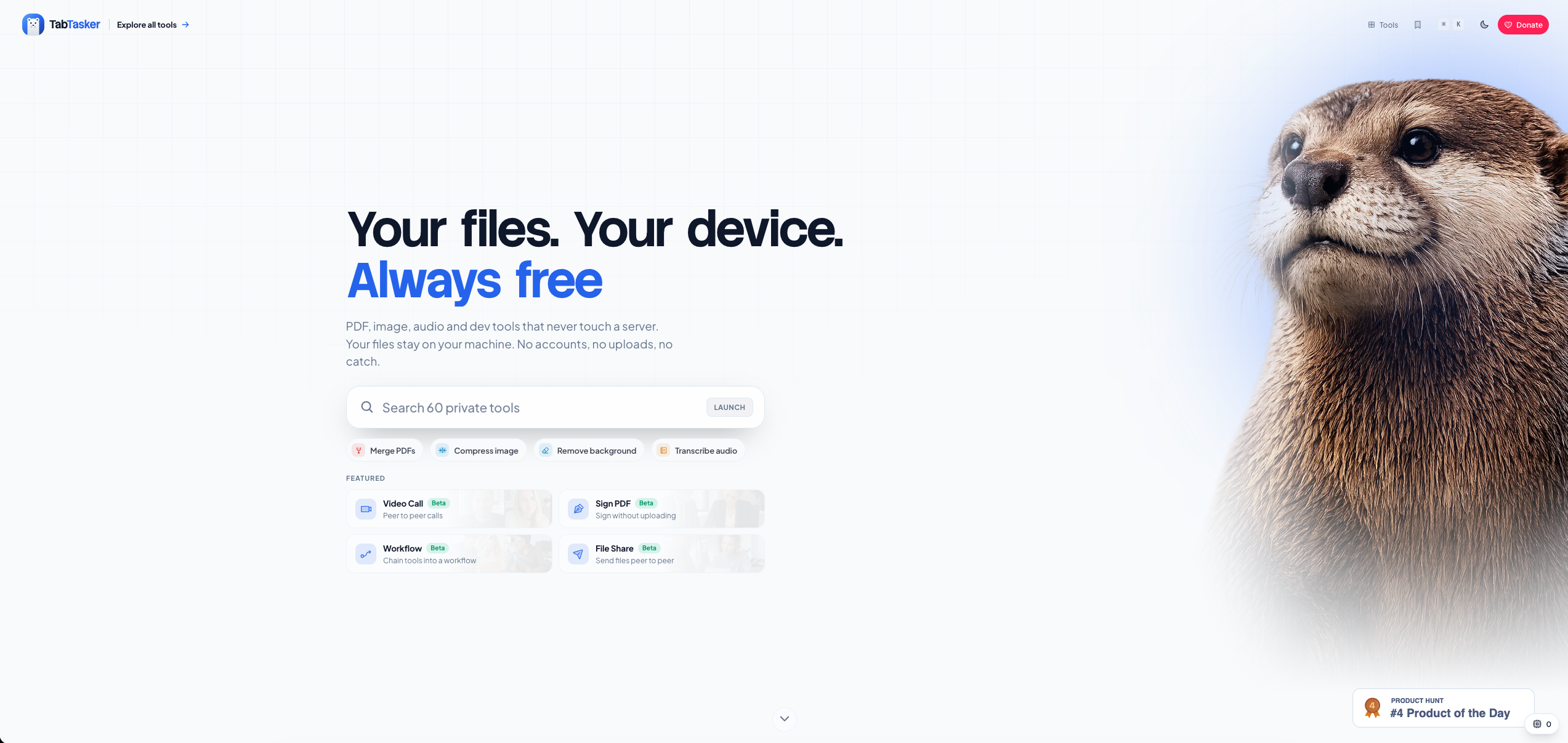
The privacy checklist items that matter most are already built in: no file uploads, no persistent storage, local export in standard formats, and no account tied to your editing history. For readers who handle sensitive images regularly, that's not a minor convenience — it's the baseline that most cloud tools still can't honestly claim.
Start with the Background Remover for an immediate test, or run the full photo cleanup workflow to see background removal, upscaling, and PNG export chained together in one private session.
Further reading and primary sources
- Five Free AI Image Editors Worth Testing in 2026 — Readability: Comparative analysis of free editor philosophies, including privacy-first design patterns and task-fit framing.
- We Tested the Best Free AI Image Editors — Decrypt: Hands-on testing of cloud editor limitations, quota behavior, and content filters.
- AI Photo Editor — DeepAI: Background on credit-based free tiers and usage expectations for AI editing tools.
- Tabtasker Local AI Tools: Technical explanation of Tabtasker's client-side processing architecture.
- GreenCube — Private Local-Model Deployment: For technical readers who want to explore self-hosted inference and local-model options beyond browser tools.