 TabTasker
Most PDF editing errors students make fall into a short, predictable list: locked files, font substitution, bad redaction, and compressed-to-oblivion images. Here are the top mistakes with one-line fixes you can act on right now.
- Locked or password-protected PDF — Request the source file from your instructor, or ask for the change-permissions password before attempting any edits.
- Font substitution causing layout shifts — Embed fonts before exporting, or convert text to vector outlines if you can't access the original typeface.
- Editing a scanned PDF without OCR — Run OCR first; editing a scanned image directly produces mismatched text blocks and broken layouts.
- Covering text with a white rectangle instead of redacting — Use a real redaction tool; a white shape only hides text visually while the underlying data stays accessible.
- Merging or splitting pages in the wrong order — Preview the page order in a thumbnail view before saving the merged file.
- Losing form fields or signatures when re-saving — Flatten the form only after all fields are filled; never re-export a signed PDF through a converter.
- Image DPI too low for print — Use at least 150 DPI for screen-only submissions and 300 DPI for print deliverables; preview at 100% before exporting.
- Metadata leaking personal or draft information — Strip document properties (author, revision history, comments) before submitting.
- File too large to upload to the LMS — Compress images inside the PDF rather than running the whole file through an aggressive online compressor that degrades quality.
- Annotations or tracked changes left in the final file — Do a final-pass annotation review and accept or delete all comments before export.
- Hyperlinks breaking after conversion — Test every link in the exported PDF, not just in the source document.
- Layers and transparencies causing print artifacts — Flatten transparencies before printing or submitting to avoid unexpected gray boxes or missing content.
Pro Tip: Before any edit session, duplicate the original file and rename it with a "_source" suffix. Work only on the copy. This one habit prevents every unrecoverable mistake on this list.
Table of Contents
- The most common PDF editing mistakes students make, explained
- A safe, repeatable editing workflow for assignments
- How to diagnose and fix locked PDFs and missing fonts
- Why local, browser-side tools reduce PDF editing problems
- Pre-submission checklist: run this before every upload
- How losing annotations and comments can hurt your submission
- Compatibility and submission requirements you need to know
- The convert-edit-save-as workflow and why keeping originals matters
- Free vs. paid PDF editors: the real tradeoffs
- Key Takeaways
- The part most students overlook
- Tabtasker handles your PDF edits locally, no upload needed
- Further reading and trusted sources
The most common PDF editing mistakes students make, explained
Understanding why each mistake happens is what stops you from repeating it. The list below pairs each error with its technical cause, a step-by-step fix, and the quick checks to run afterward.
1. Locked or password-protected PDFs
Why it happens: PDF owners can set two separate passwords: one to open the file and one to restrict changes. Opening a locked file in a viewer looks fine, but the moment you try to edit, the tool either blocks you or silently saves without your changes.

Fix: Check permissions in Adobe Acrobat under File → Properties → Security before editing. If the file is restricted, contact your instructor for the source file or the change-permissions password. Never attempt to brute-force a protected academic document.
After editing, check: Can you save a new version? Does the security tab still show restrictions? Did the file size change (a sign the edit actually wrote through)?
2. Font substitution and layout shifts
PDFs are hypersensitive to font changes: if your editor can't access the original font, it substitutes a different one, often shifting kerning and line spacing enough to push text off the page. This is the single most common cause of subtle layout failure in student submissions.
Fix: Open the PDF in a tool that shows embedded fonts (Acrobat: File → Properties → Fonts tab). If fonts are not embedded, either obtain them and embed them manually, or convert all text to vector outlines before finalizing. For printed deliverables where you can't get the font, outline conversion is the safest route.
After editing, check: Scroll through every page at 100% zoom. Look for lines that run past the margin, text that overlaps images, or headings that changed size.
3. Scanned PDFs and OCR errors
A scanned PDF is an image, not text. Trying to edit it directly produces mismatched text blocks and broken layouts. OCR works best on clean scans; free tools struggle with complex layouts and nonstandard fonts, generating errors that need manual correction.
Fix: Run OCR before any text editing. For a clean, single-column scan, most tools handle it well. For multi-column layouts or handwritten notes, plan for a manual cleanup pass. Tabtasker's searchable PDF workflow runs OCR and compression locally, so your file never leaves your device.
After editing, check: Select a paragraph of the recognized text and paste it into a plain text editor. If it reads as gibberish, the OCR pass failed and you need a cleaner scan or a different tool.
4. Redaction done wrong
Placing a white or black rectangle over sensitive text is not redaction. The underlying data remains accessible to anyone who selects the text, copies it, or opens the file in a text extractor. For grade-sensitive content, personal information, or anything your instructor asked you to remove, this is a real risk.
Fix: Use a dedicated redaction tool that removes the underlying content layer, not just covers it. After redacting, try to select the "hidden" text yourself. If you can highlight it, the redaction failed.
After editing, check: Open the file in a plain text viewer or copy-paste the redacted area into a text editor. Nothing should appear.
5. Image resolution and DPI problems
Editors and export settings often down-sample images automatically. A logo or photo can look sharp on screen but blur badly when printed if the DPI drops below the threshold. Use at least 150 DPI for screen-only documents and 300 DPI for anything that will be printed.
Fix: Set export quality explicitly in your PDF tool rather than accepting the default "optimized" setting. Preview the file at 150% zoom before exporting to catch compression artifacts.
6. Merging, splitting, and page-order problems
Merging multiple PDFs or splitting a large one is where page order mistakes hide. The error usually shows up only after submission, when an instructor opens the file and finds pages 4 and 5 swapped.
Fix: After merging or splitting, open the Thumbnails panel and scroll through every page in order before saving. Count the pages and compare to your expected total.
7. Losing form fields and signatures
Flattening a PDF collapses form fields and signatures into static content. That is sometimes intentional, but if you flatten before all fields are filled, or re-export a signed PDF through a converter, the signature becomes an image with no cryptographic validity.
Fix: Fill all form fields first, then flatten. For signed PDFs, use a signature verification tool to confirm the signature is still cryptographically valid after any post-signing edits. Never run a signed PDF through a format converter.
8. File size and compression problems
Aggressive compression reduces file size but also degrades image quality and can corrupt embedded fonts. Uploading an over-compressed PDF to an LMS often produces a file that looks fine in the uploader preview but prints badly or fails the institution's accessibility checker.
Fix: Compress images inside the PDF at a controlled quality setting rather than running the whole file through an online "shrink PDF" tool with no quality controls. Check the file size against the LMS upload limit before submission.
9. Metadata leaks
Every PDF carries document properties: author name, software version, revision history, and sometimes comments or tracked changes from earlier drafts. Submitting a file with draft comments still embedded, or with a different author name in the metadata, raises academic integrity flags.
Fix: Before submitting, open File → Properties (or the equivalent in your editor) and clear the author, subject, keywords, and comments fields. Strip revision history if your tool supports it.
10. Layers, transparencies, and print artifacts
PDFs can contain multiple layers and transparent objects. When printed or viewed on a device that doesn't support transparency flattening, these produce gray boxes, missing content, or unexpected white patches.
Fix: Flatten transparencies before printing or submitting. In most PDF editors, this is under Print Production → Flatten Transparency. Preview the flattened version before sending.
11. Hyperlinks and embedded media breaking
Links that work in your source document often break after conversion to PDF, especially if you used a relative path or a platform-specific link format. Embedded audio or video almost never survives a PDF conversion intact.
Fix: Test every hyperlink in the exported PDF by clicking it, not just in the source file. For embedded media, convert to a static screenshot with a visible URL instead of relying on the embed surviving export.
12. Hidden formatting and spacing surprises
Conversion and hidden formatting layers cause spacing, heading, and list alignment problems that only become visible at the export stage. Pasted text from websites often carries invisible line breaks or font overrides.
Fix: Before converting to PDF, paste all external text through a plain text editor to strip hidden formatting. Run a print preview in your source document and compare it to the exported PDF page by page.
Quick checks to run after any edit:
- Fonts render correctly on every page (no substitution warnings, no text overflow)
- Page count matches the expected total
- Signatures are present and cryptographically valid
- All annotations and comments have been removed
- File size is within the LMS upload limit
- Redacted areas contain no selectable text
- Hyperlinks open correctly in the exported file
A safe, repeatable editing workflow for assignments
The single most protective habit is to keep the original file untouched and work on a copy. Every step below assumes you have already duplicated the source.
Prepare
Clean your source document before converting. Strip hidden formatting, confirm image resolution, and remove any draft comments or tracked changes. Hidden formatting only becomes visible at the conversion stage, so catching it beforehand saves a second round of fixes. If your assignment came as a scanned PDF, run OCR before doing anything else.
For scheduling, build in at least 24 hours between your final edit and the submission deadline. That buffer lets you test the file on the actual submission platform, fix any upload errors, and contact your instructor if something is genuinely broken.
Edit
Choose your tool based on what the file actually needs. For a text-heavy PDF with no security restrictions, a visual PDF editor works well. For a scanned document, OCR is the first step, not an optional one. If the in-app editor inside your LMS is behaving strangely, switch to the browser version or convert to Google Docs. App-based PDF editors inside LMS platforms are prone to platform-specific bugs, including a known issue in Google Classroom that deletes typed characters when using the spacebar on iPad. Local tools sidestep these entirely.
For tool selection guidance, the complete guide to online document editors covers the tradeoffs between browser-based, desktop, and LMS-embedded editors in detail.
Verify
Open the exported PDF on a different device or browser before submitting. Check fonts, page order, file size, and that all links work. Run the pre-submission checklist in Section 6 of this article. If your course uses a specific grading platform, test the file there, not just on your own machine.
Save as
Never overwrite the original. Save the final version with a clear filename that distinguishes it from drafts.
Pro Tip: Version your filenames from the start: "essay_v1.pdf", "essay_v2_fonts_fixed.pdf", "essay_final.pdf". When something breaks at the last minute, you can roll back to the last clean version in seconds rather than starting over.
If something fails at submission time, contact your instructor with: the exact error message, the file size, the tool you used to create the PDF, and a screenshot of the problem. That information cuts troubleshooting time significantly.
How to diagnose and fix locked PDFs and missing fonts
When a PDF won't let you edit it, or the text looks wrong after editing, the cause is almost always one of two things: security restrictions or missing fonts.
Diagnostic checklist:
- Open File → Properties → Security tab. Note what is restricted (printing, editing, copying).
- Open File → Properties → Fonts tab. Any font listed as "not embedded" is a substitution risk.
- Look for font substitution warnings in your editor's status bar or output log.
- Try selecting a line of text. If the cursor jumps or the selection box is misaligned, font substitution has already occurred.
Do's and don'ts:
- Do request the original editable source file from your instructor when the PDF is locked.
- Do embed fonts before exporting any PDF you've edited.
- Do convert text to vector outlines for printed deliverables when the original font is unavailable.
- Don't use white rectangles to "hide" content — the text underneath is still selectable.
- Don't run a signed PDF through a converter to unlock it; the signature will be invalidated.
| Method | Best for | Main risk | Ease of recovery |
|---|---|---|---|
| Convert to Word | Text-heavy, unlocked PDFs | Layout shifts, font changes | Medium |
| OCR image-to-text | Scanned or image-only PDFs | Recognition errors in complex layouts | Low (manual cleanup needed) |
| Visual PDF editor | Minor text or image edits | Font substitution if fonts not embedded | High |
| Local in-browser tool (no upload) | Privacy-sensitive files, LMS compatibility | Depends on tool's font library | High |
When to contact your instructor: if the PDF is locked with a change-permissions password you don't have, if the source file is unavailable, or if the assignment requires a fillable form you can't access, email your instructor before the deadline with a clear description of the restriction. Most instructors can provide the source file or grant a brief extension for a genuine technical barrier.
Why local, browser-side tools reduce PDF editing problems
Uploading a PDF to an online editor introduces a category of problems that have nothing to do with your editing skills: upload timeouts, server-side font substitution, platform-specific rendering bugs, and the quiet risk that your file is stored on someone else's server. Local, browser-side tools eliminate all of those at once.
Tabtasker processes every file directly in your browser. Nothing is uploaded, no account is required, and your document never touches an external server. For students handling drafts with personal information, grade data, or research that hasn't been published yet, that matters.
What Tabtasker offers for common student tasks:
- OCR to convert scanned PDFs into searchable, editable text
- Merge and split to reorder pages without server-side processing
- Compress to reduce file size without losing control of quality settings
- Redaction that removes underlying content, not just covers it
- E-sign and signature verification to confirm a signed PDF hasn't been altered
- Local processing that avoids LMS app editor bugs entirely
A minimal Tabtasker workflow for a scanned assignment:
- Open the searchable PDF tool in your browser. No login, no upload prompt.
- Load your scanned PDF locally, run OCR, and compress to your target file size.
- Verify the recognized text by selecting a paragraph and checking it reads correctly, then export.
Pro Tip: If your assignment contains personal data, research notes, or anything your institution's data policy covers, local processing isn't just convenient — it's the responsible choice. Uploading to a free online tool means accepting whatever that tool's privacy policy says about your file.
For a deeper look at OCR accuracy and its limits, the PDF OCR guide covers what free tools get wrong and when you need a cleaner scan.
Pre-submission checklist: run this before every upload
A final-pass review takes about five minutes and catches the mistakes that cost points.
- File opens without errors — Open the PDF in a different viewer (not the one you edited in) and confirm it loads completely.
- Fonts render correctly — Scroll every page at 100% zoom; look for text overflow, unexpected font changes, or missing characters.
- No hidden metadata — Check File → Properties and clear author, comments, and revision fields.
- Redaction is permanent — Try to select any redacted text. If it highlights, redo the redaction with a proper tool.
- File size is within the limit — Check the LMS upload limit before submitting; most platforms cap at 10–25 MB for PDFs.
- Signatures are intact — Open the Signatures panel and confirm all signatures show as valid, not "unknown" or "invalid."
- Annotations and comments removed — Open the Comments panel and confirm it is empty.
- Page order is correct — Open the Thumbnails panel and count pages against your expected total.
- Print preview looks right — Run a print preview and check margins, bleed, and that no content is cut off.
- Mobile/device preview — Open the file on your phone or a second device to catch rendering differences.
- Searchable text (OCR check) — Use Ctrl+F to search for a word you know is in the document. If it doesn't find it, the PDF is still image-only and needs OCR.
If a check fails:
- Fonts wrong: re-embed fonts or convert text to outlines and re-export.
- File too large: compress images at a controlled quality setting, not the whole file.
- Redaction incomplete: redo with a dedicated redaction tool and verify again.
- Signature invalid: do not re-export the signed PDF; use the original signed version.
How losing annotations and comments can hurt your submission
Annotations, comments, and tracked changes serve different purposes at different stages of a document's life. During drafting, they're useful. In a final submission, they're a liability.
Most PDF editors preserve annotations by default when you save. That means draft notes to yourself, instructor feedback from a previous version, or peer-review comments can travel with the file unless you explicitly remove them. Some LMS platforms strip annotations on upload; others don't. You can't rely on the platform to clean your file for you.
The fix is deliberate, not automatic. Open the Comments or Annotations panel in your editor, review every entry, and delete anything that shouldn't be in the final version. Accept or reject all tracked changes before converting to PDF. A quick final pass that removes annotations and verifies redaction is one of the highest-value pre-submission steps most students skip.
Compatibility and submission requirements you need to know
Not every PDF is the same format. PDF 1.4, PDF 1.7, and PDF/A are different standards with different feature support. An LMS built around PDF/A for archival purposes may reject a PDF 1.7 file with embedded JavaScript or transparency layers.
Before submitting, check your course syllabus or assignment instructions for a required file format. If none is specified, PDF 1.4 or PDF/A-1b are the safest choices for academic submission: widely supported, no active content, and compatible with most accessibility checkers. Keeping software updated and exporting to a widely compatible PDF standard reduces cross-device display and print differences.
File permissions matter too. Some instructors set PDFs to prevent printing or copying so students can't redistribute materials. If you receive a restricted PDF and need to annotate it for class, ask your instructor for an unrestricted version rather than attempting to work around the permissions.
The convert-edit-save-as workflow and why keeping originals matters
The convert-edit-save-as workflow is the safest pattern for any PDF edit. Convert the file to an editable format if needed (Word, Google Docs), make your changes, then export back to PDF. Never edit the original directly and overwrite it.
Keeping the original matters for one practical reason: PDF editing is lossy in ways that aren't always visible immediately. Font substitution, compression artifacts, and layer flattening can accumulate across multiple save cycles. If you discover a problem three edits in, the original is your only clean starting point.
Accessibility is part of this workflow, not an afterthought. Before exporting, confirm that the PDF has searchable text (not image-only), that heading structure is preserved for screen readers, and that any images have alt text if your institution's accessibility policy requires it. Building a repeatable academic workflow that includes these checks from the start saves time across every assignment.
Free vs. paid PDF editors: the real tradeoffs
Free PDF editors are genuinely useful for basic tasks: filling a form, adding a signature, or compressing a file. The problems start when students use them for tasks they weren't built for.
Most free tools work by overlaying content rather than truly modifying the PDF's structure. Basic editors that claim editing capability often only overlay or hide existing text; they don't modify original content and can produce artifacts or misalignments. That's fine for a sticky note but not for a text correction that needs to look native.
The other real tradeoff is privacy. Many free online PDF tools are free because they process your files on their servers and monetize the data or the traffic. If you're not paying for the product, it's worth asking what the product actually is. For academic files containing research, personal information, or unpublished work, that question has a practical answer: use a tool that processes locally.
Paid desktop editors like Adobe Acrobat give you true content editing, reliable font embedding, and proper redaction. The cost is real, though, and most students don't need the full feature set. The practical middle ground is a local browser-based tool that handles the most common student tasks (OCR, compress, merge, sign, redact) without uploads, without accounts, and without a subscription.
Key Takeaways
Avoiding PDF editing errors as a student comes down to one discipline: verify the output, not just the input.
| Point | Details |
|---|---|
| Keep the original file | Always work on a copy; rename originals with "_source" so you can recover from any edit mistake. |
| Embed fonts before exporting | Font substitution is the leading cause of layout shifts; check the Fonts tab in File → Properties before every export. |
| Redaction requires a real tool | A white rectangle leaves underlying text selectable; use dedicated redaction that removes the content layer. |
| Test on the submission platform | Open the exported PDF on a different device and in the LMS before the deadline to catch compatibility failures. |
| Tabtasker for local, private edits | Tabtasker runs OCR, compression, redaction, and signing in-browser with no uploads, protecting your file and avoiding LMS editor bugs. |
The part most students overlook
The PDF mistakes that actually cost points aren't the dramatic ones. Nobody submits a blank file and calls it done. The costly mistakes are the quiet ones: a font that substituted silently, a white box that "hid" text that an instructor can still select, a metadata field that still shows a previous author's name, or a signature that became an image the moment you ran the file through a converter.
What makes these hard to catch is that they look fine in the tool you used to create them. The problem only appears on someone else's device, in a different viewer, or under a different operating system. That's why the workflow matters more than the tool. A careful convert-edit-verify-save-as pattern, combined with a final check on a second device, catches nearly all of them before they reach your instructor.
There's also a subtler point worth making about free online tools. The privacy question isn't paranoia. Academic files often contain research in progress, personal data, or work covered by your institution's data policy. Uploading that to a server you don't control, run by a company whose business model you don't know, is a real decision with real consequences. Local processing isn't a premium feature. It's the baseline you should expect.
Tabtasker handles your PDF edits locally, no upload needed
Most PDF problems students face come down to two things: the wrong tool for the job, and a file that left your device when it shouldn't have. Tabtasker is built around the opposite premise. Every tool runs directly in your browser, your files stay on your device, and there's no account to create or subscription to manage.
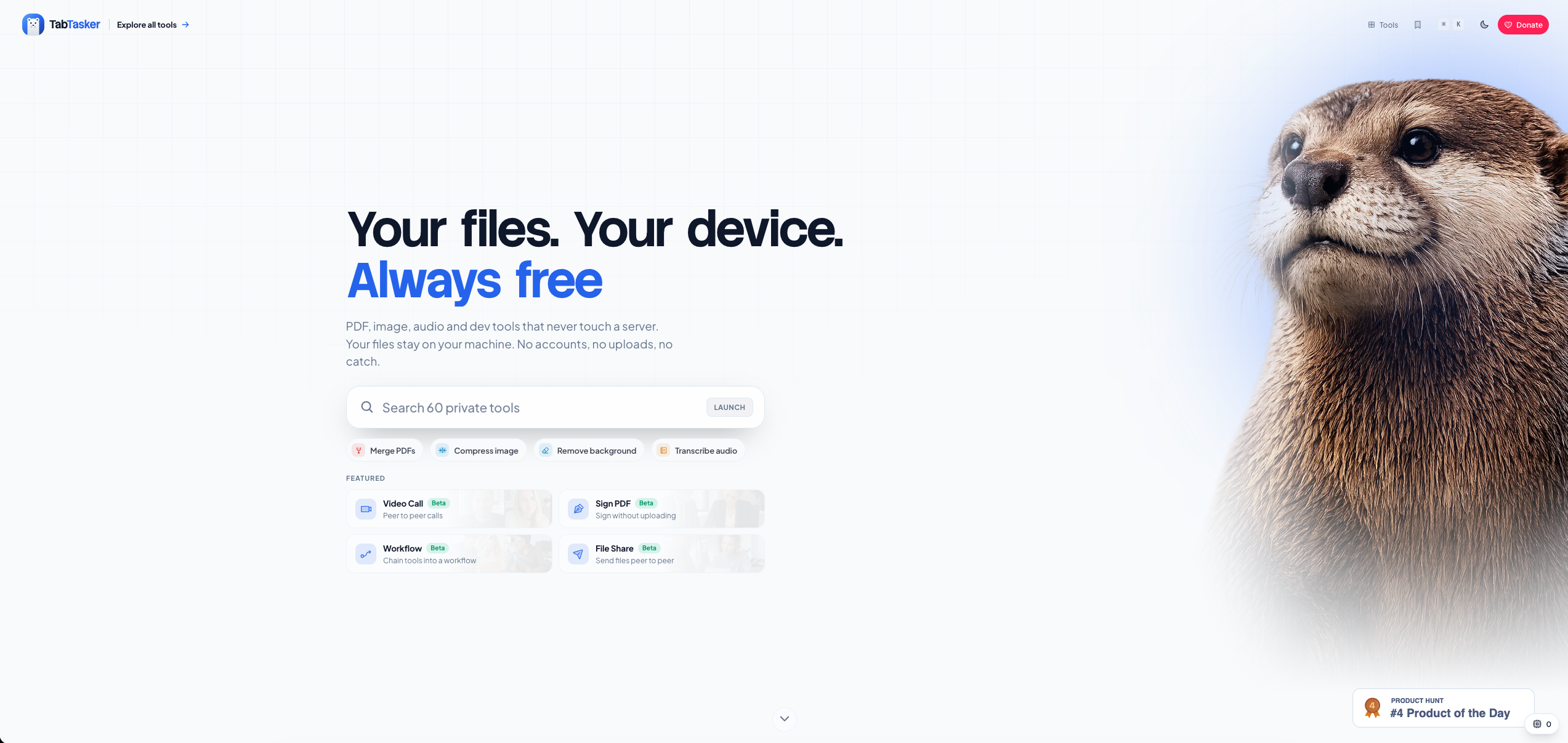
For a typical student workflow, here's how it works in three steps:
- Open Tabtasker's searchable PDF tool in any browser. No login, no file upload.
- Load your PDF locally, run OCR to make it searchable, and compress it to fit your LMS file size limit.
- Export the finished file and run the pre-submission checklist above before uploading.
For text prep before converting to PDF, the in-browser text editor lets you strip hidden formatting locally before export. All processing stays on your machine.
Tabtasker is free to use. Give it a try before your next submission deadline.
Further reading and trusted sources
- Adobe Acrobat: Unable to edit PDF files — Adobe's official guide to diagnosing why a PDF won't let you edit it, including password and permissions issues.
- How to Edit a PDF: 5 Methods that Work — Practical overview of editing methods with notes on font embedding and scanned PDF handling.
- PDF Editing Mistakes That Make Documents Look Unprofessional — Covers redaction failures, image DPI, and the white-box mistake in detail.
- Preparing Your Assignment for Final PDF Submission — Academic-focused guide to hidden formatting and pre-submission checks.
- 5 Common PDF Editing Challenges and How to Solve Them — Covers overlay artifacts, compatibility issues, and when basic editors fall short.
- Google Classroom PDF Editor Known Issue — Official support note on the LMS app editor bug and recommended workarounds.
- Everything You Need to Know About PDF OCR — Tabtasker's in-depth guide to OCR accuracy, limitations, and when a cleaner scan is needed.
- How to Check a Signed PDF Has Not Been Tampered With — Step-by-step signature verification guide for students submitting signed documents.
- Best Student Time Management Tools — Useful comparison of productivity tools for building a reliable pre-submission schedule.