 TabTasker
What types of PDF edits actually matter for assignments?
The most useful types of PDF edits for assignments fall into five categories: direct text editing, annotation, form filling, image and page modifications, and digital signing. Knowing which type you need before opening a tool saves time and prevents the frustration of realizing a free web editor can't do what you actually need.
- Direct text editing: Clicking into existing text to fix a typo or reword a sentence. Only works on text-based PDFs with a real text layer, not scanned images.
- Annotation: Adding highlights, sticky notes, comments, or drawings on top of the original content. The underlying document stays unchanged, which is why educators rely on this for feedback.
- Form filling: Typing into pre-built form fields on interactive PDFs, or overlaying text boxes on flat PDFs that weren't designed for input.
- Image and page modifications: Inserting, resizing, or replacing images; reordering, cropping, or deleting pages.
- Digital signing: Adding an e-signature or initials to certify submission or approval.
The distinction between editing the text layer and adding an annotation layer matters for academic integrity. Annotations do not alter the original document, so a graded assignment stays intact while feedback accumulates on top.
Which PDF editor should you use for academic work?

The right tool depends on how deep your edits need to go. Quick annotation on a Mac calls for something different than rebuilding a scanned lab report with OCR. The table below maps each editor to its strongest use case.
| Tool | Best For | Pricing | Platform | Editing Features | Ease of Use |
|---|---|---|---|---|---|
| Adobe Acrobat Pro | Full professional editing and security | Paid subscription | Windows, Mac, Web, iOS | True text edit, OCR, forms, signing, security | Moderate |
| Foxit PDF Editor | Advanced annotation and collaboration | Paid (free trial) | Windows, Mac, Web, iOS | Annotation, forms, collaboration, OCR | Moderate |
| EaseUS PDF Editor | Affordable edits for students | Paid (free version) | Windows | Text edit, annotation, page management | Easy |
| PDF Candy | Quick no-install web edits | Free / freemium | Web | Text boxes, image add, basic edits | Very easy |
| PDF Expert | Mac annotation and light editing | Paid (free trial) | Mac, iOS | Annotation, form fill, light text edit | Easy |
| Microsoft Teams | School assignment annotation workflows | — | Windows, Mac, Web, iOS | Annotation on personal copies | Easy |
| pdfFiller | Form creation and e-signatures online | Paid subscription | Web, iOS, Android | Form fields, signing, annotation | Easy |
| Apple Preview PDF Editor | Lightweight offline Mac markup | Free (built-in) | Mac | Annotation, form fill, text boxes | Very easy |

Adobe Acrobat Pro sets the benchmark. It's the only tool that combines true text editing with paragraph reflow, advanced security, watermarking, and OCR in one place. For a thesis or a formatted research paper, nothing else comes close.
Foxit PDF Editor is the strongest alternative for students who collaborate. Its shared review tools let multiple people annotate the same document simultaneously, which is useful for group projects or peer review assignments.
EaseUS PDF Editor keeps things accessible. The interface is direct, the learning curve is short, and the price is lower than Acrobat, making it a practical pick for students who need more than a free web tool but don't need professional-grade features.
PDF Candy is honest about what it is: a web tool for fast, one-off edits. Adding a text box, inserting an image, or merging pages takes seconds. What it can't do is edit existing text directly, and uploading a file to any web service carries a privacy trade-off worth considering.
PDF Expert earns its place on Mac for how well it handles annotation. Highlighting, commenting, and filling forms feel natural. It's not the tool for heavy text restructuring, but for reviewing and marking up readings, it's fast.
Microsoft Teams deserves a mention because many US schools already use it. Students can annotate their own copy of an assignment PDF directly inside Teams without touching the original, which keeps grading clean.
pdfFiller stands out for form-heavy workflows. Drag-and-drop field creation makes it practical for educators who need to build fillable assignment sheets or consent forms quickly.
Apple Preview PDF Editor comes preinstalled on every Mac. For basic markup, it's genuinely capable: highlights, sticky notes, text boxes, and simple form filling all work without downloading anything.
How to perform common PDF edits for your assignments
Editing selectable text directly
Open the PDF in Adobe Acrobat Pro, Foxit PDF Editor, or EaseUS PDF Editor. Click the text editing tool, then click the line you want to change. Fix the typo or reword the sentence. Save. This only works when the PDF has a real text layer, meaning you can highlight words with your cursor.
Adding text boxes over locked or scanned PDFs
When direct editing isn't possible, overlay a text box over the problem area. Match the font size and color to the surrounding text as closely as you can. For a single corrected word or a missing date on a title page, this method is fast and effective.
Annotating for feedback or review
- Open the PDF in your chosen editor or platform.
- Select the highlight tool and drag over the relevant text.
- Right-click to add a comment or sticky note explaining your feedback.
- Use the drawing tool for diagrams or freehand marks if needed.
- Save the annotated version separately to preserve the original.
Filling out interactive forms
Fillable PDFs have pre-built fields you click into and type. If the form is flat (no clickable fields), add text boxes manually using any editor listed above. pdfFiller and Adobe Acrobat Pro both let educators convert flat forms into interactive ones.
Adding or replacing images
In Adobe Acrobat Pro or Foxit PDF Editor, use the image editing tool to insert a new image or click an existing one to resize or swap it. For a lab report with a chart or a design assignment with a figure, this keeps everything in one file.
Pro Tip: Before submitting, always open the final PDF in a plain viewer like Apple Preview or Adobe Reader to confirm your edits look correct. Fonts and text boxes sometimes shift between editors.
Privacy and offline vs. online editing
Local applications keep your files on your device. Cloud-based editors require an upload, and that upload goes to a third-party server. For assignments containing personal data, research notes, or anything sensitive, offline tools are the safer choice. If you're not paying for the product, you might be the product.
How editable PDFs work in educational platforms
Interactive vs. flat PDFs
An interactive PDF has form fields, checkboxes, and clickable elements. A flat PDF is essentially a printed page saved as a file. Students can type into interactive PDFs directly; flat ones require text box overlays or conversion first.
Platform-specific behavior
- Microsoft Teams: Assignments distributed as PDFs give each student a personal copy. The built-in toolbar supports highlights, comments, and drawings. The original stays untouched for the instructor.
- Google Classroom: PDFs don't open natively for editing. The most reliable workaround is converting the PDF to a Google Doc via Google Drive, editing it, then exporting back to PDF for submission.
- Canvas and Blackboard: These LMS platforms generally accept annotated PDFs as submissions. Compatibility depends on how the file was saved; always export as a standard PDF rather than a proprietary format.
Common limitations and workarounds
- Locked PDFs block text editing. You can still add text boxes or annotations in most editors, but you cannot change the underlying content.
- Scanned PDFs appear as images. Without OCR, there is no text layer to edit. Run OCR first in Adobe Acrobat Pro or Foxit PDF Editor, then edit.
- File size limits on LMS platforms can block large annotated PDFs. Compress the file before uploading using a tool that doesn't require an upload to a third-party server.
Pro Tip: Educators sharing PDFs for student completion should always test the file in the same platform students will use. A fillable form that works in Acrobat may appear flat inside a browser-based LMS viewer.
Why OCR and annotation are the foundation of PDF editing for academic work
OCR (optical character recognition) transforms a scanned image into machine-readable text. Without it, a scanned syllabus or a photographed worksheet is just a picture inside a PDF container. Running OCR makes the text selectable, searchable, and editable, which is the prerequisite for any meaningful text-level change.
Annotations work differently. They sit in a separate layer on top of the original content. Highlights, sticky notes, text boxes, and drawings add information without touching the underlying text, which is exactly why they're the standard tool for grading and peer feedback. A professor's comments don't overwrite your work; they sit alongside it.
For students dealing with scanned or locked PDFs, the practical path is: run OCR if you have access to a tool that supports it, then edit the text layer directly. If OCR isn't available, overlay text boxes for corrections. Understanding PDF OCR in depth helps you choose the right approach before you waste time in the wrong tool.
Privacy matters here too. Running OCR or editing PDFs in a cloud-based tool means your document leaves your device. For academic work with sensitive content, that's a risk worth weighing carefully.
Tabtasker offers a private alternative for PDF editing
Most free online PDF editors ask you to upload your file before you can do anything with it. That's the trade-off that rarely gets mentioned upfront.
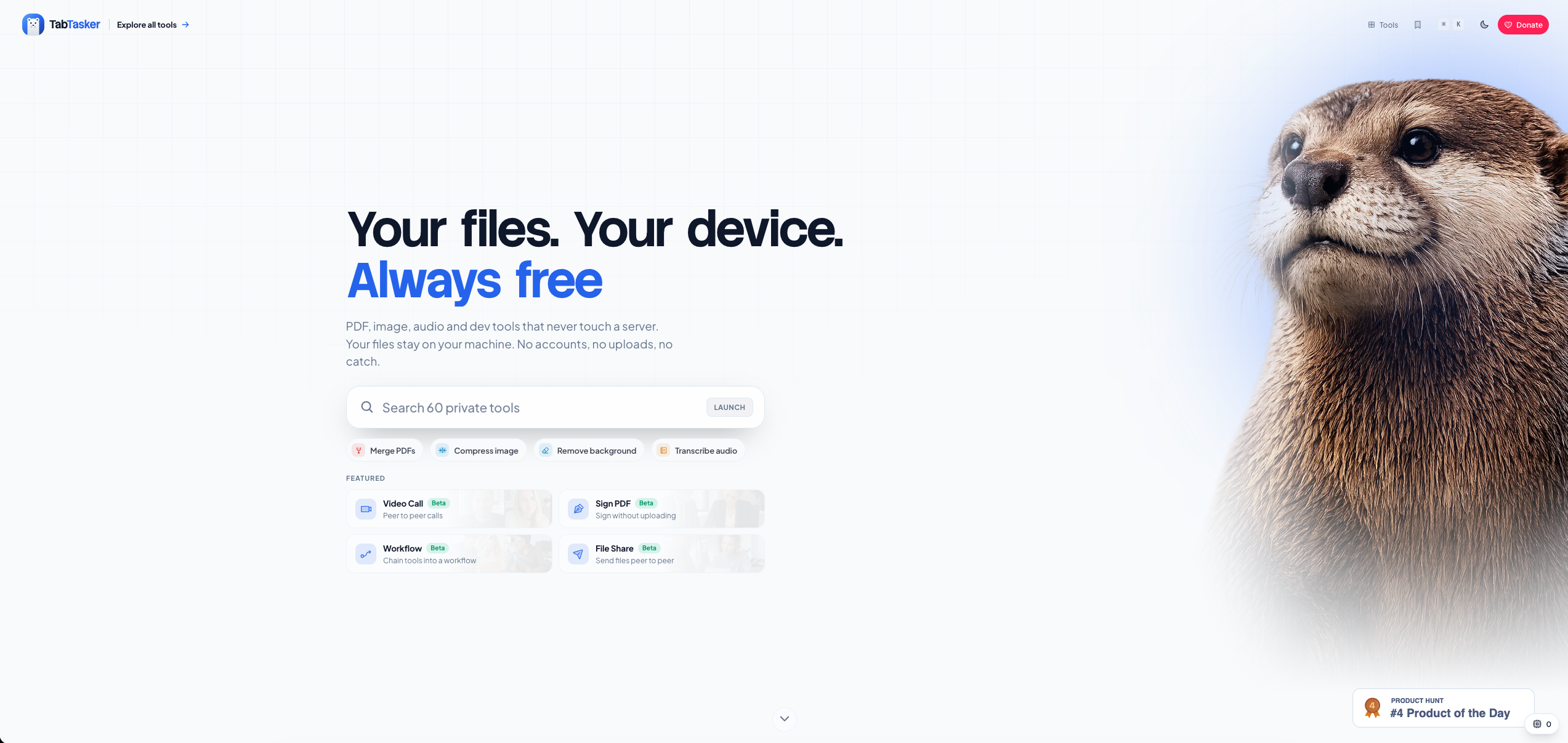
Tabtasker's free offline tools process files directly in your browser, with no uploads and no account required. Your assignment stays on your device from start to finish. For students handling research data, personal statements, or any document you'd rather not hand to a third-party server, that's a meaningful difference. You can also share files privately between devices without routing them through an external service. It's a different approach from the editors compared above, and for privacy-conscious academic work, it's worth knowing it exists.
Key Takeaways
The most effective PDF editing approach for assignments depends on the document type, the platform, and how much of the original content needs to stay intact.
| Point | Details |
|---|---|
| Five core edit types | Text editing, annotation, form filling, image changes, and digital signing cover nearly every academic PDF task. |
| Annotations preserve integrity | Highlights and comments layer over original content without altering it, keeping graded work intact. |
| OCR unlocks scanned PDFs | Without OCR, a scanned PDF is an image; running OCR creates a text layer you can actually edit or search. |
| Platform behavior varies | Google Classroom, Microsoft Teams, and Canvas each handle editable PDFs differently; test before distributing. |
| Tabtasker for privacy | Tabtasker processes PDF edits locally in the browser, with no uploads, making it suited for sensitive academic documents. |